Showing posts with label national debt. Show all posts

Wednesday, March 25, 2009

Ten Trillion and Counting


Frontline does it again. I plan to encourage my students in my macro principles class to watch this outstanding video on the exploding national debt.

"All of the federal government's efforts to stem the tide of the financial meltdown have added hundreds of billions of dollars to an already staggering national debt, a sum that is expected to double over the next 10 years to more than $23 trillion. In Ten Trillion and Counting, FRONTLINE traces the politics behind this mounting debt and investigates what some say is a looming crisis that makes the current financial situation pale in comparison."

Sunday, February 15, 2009

Planet Money

There is an economics blogcast that I plan to use as a current events supplement for my introductory macro courses. Planet Money is a multimedia project from NPR that covers the global economy without the use of a lot of econtalk. Planet Money is a social website (podcasts, blogs, twittering) that is aimed at folks who are relatively new to the world of economics. Explaining economic jargon is a key component of its mission.

Incorporated within the Planet Money blog are regularly updated podcasts which feature interviews and analysis from economists, reporters, and even regular folks concerning the top econ stories of the day. Podcast conversations are often interrupted to explain economic terminology.

You can also interact with the Planet Money staff in real time, thanks to their Twitter feed, and/or join the Planet Money Facebook group

Simon Johnson and James Kwak at Baseline Scenario have started collaboration with Planet Money to supply introductory articles on important topics in economics. For example there is an article on the National Debt for Beginners.

Planet Money is charmingly open educational blogcast that explains the challenges facing the economy in a way that any interested person can understand. It is consistently among the top podcast downloads on i-Tunes.

Tuesday, February 03, 2009

Indebted: We're broke, let's fix it!

Indebted: We’re Broke, Let’s Fix It

“MTV has joined forces with the Peter G. Peterson Foundation to create Indebted, a campaign for college students that raises awareness about the dangers of excessive personal and government debt, and promotes action to help stop the fiscal crisis in the U.S.”

IOUSA


"Check out the acclaimed film I.O.U.S.A. now. It's 30 minutes that will change everything."
After reading your text book section concerning the national debt, watch this video. Imagine that you are a policymaker, advisor, or opinion columnist. What is causing America’s fiscal meltdown, and what do you think should be done?

Monday, November 19, 2007

Traveling Economists Sound Alarm on Fiscal Crisis


You will be learning about fiscal policy and the public debt as you read Chapter 12 in your text. The Concord Coalition's "Fiscal Wake-Up Tour," is a series of forums designed to educate the public about the growing structural deficits that we will incur as a result of the impending retirement of the “Baby Boom” generation and rising health care costs. The star of the tour is David Walker, Comptroller General of the United States Government Accountability Office, which evaluates the performance of the federal government. Walker is dedicated to educating folks about the need for “generationally responsible” fiscal policy.

Can’t make it to the tour? Well you can watch recent tours by clicking here.

According to NPR: “The Fiscal Wake-Up Tour is ramping up its schedule in the coming months, trying to crowbar budget issues into the agendas of the presidential candidates. If they can get regular Americans to think about the budget, and start asking politicians for a solution, these budget experts will be satisfied.”

Extra Credit: How big is the national debt — plus the obligations the federal government has promised to pay out in the future? Cite your source. If you are the first student to send me an e-mail (kwoodward@saddleback.edu) with the answer, you will be rewarded with two extra credit Discussion Board points. Only two points extra credit per student can be earned in any given week from the blog questions.

Wednesday, February 14, 2007

A Picture Can Save a Thousand Words


Robert Samuelson is one the country’s foremost economics journalists. In the current issued of Newsweek he has an article that is worth reading before you study fiscal policy, budget deficits, and the national debt, topics that are covered in Chapters 14 and 15 of your text.

Samuelson’s article focuses on the attached chart called “Shifting Priorities”. The pie chart compares the composition of federal government spending in 1956 and 2006. There has been quite a change in the face of federal spending.

Samuelson maintains in the article that:

“It might help if Americans called welfare programs—current benefits for select populations, paid for by current taxes—by their proper name, rather than by the soothing (and misleading) labels of "entitlements" and "social insurance." That way, we might ask ourselves who deserves welfare and why. We could consider all of federal spending and not just small bits of it. But most Americans don't want to admit that they're current or prospective welfare recipients. They prefer to think that they automatically deserve whatever they've been promised simply because they've been promised. They do not want to pose the basic questions, and their political leaders mirror that reluctance. This makes the welfare state immovable and the budget situation intractable.”

Extra Credit: Briefly explain why Samuelson maintains that “both liberals and conservatives, in their own ways, peddle phony solutions” to the budget deficit problem. If you are the first student to send me an e-mail (kwoodward@saddleback.edu) with a plausible explanation, you will be rewarded with two extra credit Discussion Board points. Only one blog extra credit question per student can be answered in any given week for Discussion Board extra credit.

Sunday, October 29, 2006

Wake Up: A Storm is Coming!


A looming fiscal generational storm promises to make coping with Katrina look like child’s play. Yesterday’s Washington Post had an informative article on a very important long run macro challenge. The article “GAO Chief Warns Economic Disaster Looms” described the Concord Coalition's "Fiscal Wake-Up Tour," a series of forums designed to educate the public about the growing structural deficits that we will incur as a result of the impending retirement of the “Baby Boom” generation and rising health care costs. The star of the tour is David Walker, Comptroller General of the United States Government Accountability Office, which evaluates the performance of the federal government. Walker is dedicated to educating folks about the need for “generationally responsible” fiscal policy.

This statement from the article is on the money:
“The subject is short on political theatrics and long on complicated economics, scary graphs and very big numbers. It reveals serious problems and offers no easy solutions. Anybody who wanted to deal with it seriously would have to talk about raising taxes and cutting benefits, nasty nostrums that might doom any candidate who prescribed them.” In other words no politician is going to touch the subject of unsustainable long run deficits until the chickens come home to roost.

Luckily in this wired age, I didn’t have to just read about the tour. There is a webcast available of the event held at the University of Texas, complete with slides and a budget simulator. The webcast was scarier than Halloween.

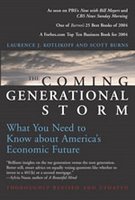
Another great resource on our long run debt challenge is a recent book called The Coming Generational Storm. Authors Laurence Kotlikoff and Scott Burns warn that if our government continues on the course it has set, we'll see skyrocketing tax rates, drastically lower retirement and health benefits, high inflation, a rapidly depreciating dollar, unemployment, and political instability." The Coming Generational Storm is must read economics. There really is no such thing as a free lunch, and we’ll start to pay long after this course is over. If you are tired of reading, you can hear Professor Kotlikoff discuss his book at MIT by clicking here.

Chapter 15 on “Politics, Deficits, and Debts” in your Colander text provides a good background for thinking about deficits and debt. This is an interesting (if depressing) topic for the Discussion Board. Will there be a generational storm? What should we be doing now to prepare?

Here are some potential final exam questions on “Politics, Deficits, and Debts”:

1. What is a budget deficit?
2. What is a structural deficit?
3. Define the national or public government debt?
4. What are the implications of the fact that the U.S. Social Security System is a largely unfunded "pay as you go" system?
5. What are the challenges to the Social Security System and the federal budget that will arise with the retirement of the baby boomers?
6. Why do economists measure the national debt relative to GDP?
7. External government debt is________? What challenge does it present?

Extra Credit:

Send me the answer to any of the above final exam questions. If you are the first student to send me an e-mail (kwoodward@saddleback.edu) with a given answer, you will be rewarded with two extra credit Discussion Board points. Only two points extra credit per student can be earned in any given week from the blog questions.