Showing posts with label CPI. Show all posts

Wednesday, October 17, 2007

Consumer Prices Rise


The most widely reported measurement of inflation is the Consumer Price Index (CPI). The Consumer Price Index (CPI) is a measure of the overall cost of the goods and services bought by a typical consumer. The CPI measures the cost of a fixed basket of goods and services relative to the cost of that same basket of goods in a base year. The CPI is used to monitor changes in the cost of living over time. When the CPI rises, the typical family has to spend more dollars to maintain the same standard of living.


Today (October 17) the Bureau of Labor Statistics released the CPI Report for September. U.S. consumer prices rose 0.3% in September, which was the fastest rate in four months. Consumer prices were up 2.8% from a year ago. Sure seems like inflation is rising higher than that to me! Both the Wall Street Journal and the New York Times have good articles today about the September CPI News Release.

You learn more about the Consumer Price Index when we cover Chapter 7 of your e-book.


Late Start Econ 2 Extra credit: What do economists mean by “core inflation”? Why is it important? The answer may not be in your text. If you are the first student to send me an e-mail at(kwoodward@saddleback.edu) with the answer, you will be rewarded with two extra credit Discussion Board points. Only two points extra credit per student can be earned in any given week from the blog questions.

Wednesday, October 18, 2006

Inflation or Deflation for Consumers?


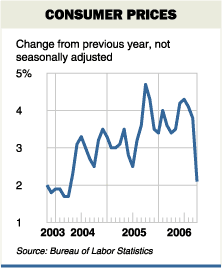
This morning the Bureau of Labor Statistics released the most important point inflation number: the Consumer Price Index (CPI). Falling energy prices brought the overall “headline” CPI down about one half of 1% for the month of September. However the core CPI, which is watched more closely by the Federal Reserve, actually increased by 2/10 of 1% during September.

The core CPI strips out food and energy prices out of an inflation number. (See yesterday’s MacroMind.) The core CPI didn't plunge at all, but actually increased, spurred on by increases in housing and clothing. In fact if you look at the core CPI rate of inflation over the past year it's coming in just under 3%, which is the highest increase in ten years, and a rate of change which tends to make the Federal Reserve feel uncomfortable. The Fed (actually the Federal Open Market Committee) has a meeting next week, and they are widely expected to hold short term interest rates steady.

Meanwhile, in Southern California local consumer prices rose 0.5%, and 3.4% in the past year as reported in the Orange County Register. We’re running way over the national average here, as we do in most things. If your boss didn’t give you at least a 3.4% raise in the past year, your purchasing power has fallen, and your real income is down.

Midterm Questions:
Let me share with you a few questions concerning the consumer price index and inflation that you might see on your midterm.
-Why is inflation undesirable?
-According to the Bureau of Labor Statistics CPI survey which category of spending represents the largest part of consumer spending?
-Price indices like the CPI are calculated using a base year. What is the value of a price index during the base year?

Extra Credit:
Go to the Bureau of Labour statistics inflation calculator. Find how much buying power a dollar would have in the year that you were born as compared to 2006? Explain. If you are the first student to send me an e-mail with the answer, you will be rewarded with two extra credit Discussion Board points. Only two points extra credit per student can be earned in any given week from the blog questions, so if you have already earned extra credit, please no e-mails. You can also post directly to the blog.

Today instead of typing the blog I'm using a voice recognition program. I suppose I shouldn't tell you the name of the software program, but it works pretty well. The accuracy rate is far higher than voice recognition programs that I've tried to use in the past. Maybe soon we'll finally be freed from the drudgery of typing, which will be really neat. Technology marches on. Whatever happened to secretaries?

Tuesday, October 17, 2006

Painting the Big Picture


There was a plethora of macro data released today. Inflation as measured by the Producer Price Index (PPI) came down in September, thanks to lower oil prices last month. The PPI measures changes in the cost of items purchased by businesses in wholesale markets. The PPI may give an early indication as to where overall inflation is headed. The drop was very sharp in the overall index, though the monthly change in core inflation (inflation excluding food and energy) was higher than many economists had expected. Tomorrow, we’ll get a look at the most closely watched measure of inflation, which is the Consumer Price Index (CPI).

The U.S. Census Bureau estimates that the population of the United States topped 300 million people today. We’ve still got a long way to go until we catch up with China, which is estimated to have about 1 billion and 300 million people.

In other macro news, the Federal Reserve said industrial production dropped in September by 0.6%, while capacity utilization fell 0.6% to 81.9%. Not so good.

I’m not sure quite what to make of all these numbers. Macrominds are always careful about reading too much into one month’s worth of data. To me the big picture points to a slowing of economic growth.

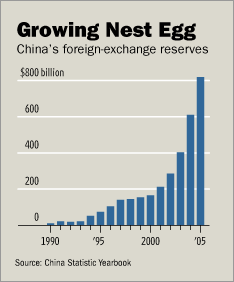
A story (at least in terms of its long run significance) that caught my attention was a report in The Wall Street Journal that China’s foreign exchange reserves had topped one trillion dollars:

"Sometime in the next few days, China's holdings of foreign currencies and securities will top $1 trillion -- a sum greater than the annual economic output of all but nine countries. The rapid growth in these so-called foreign-exchange reserves has made Beijing a colossus in the financial world, cushioned against shocks at home, but potentially able to trigger them abroad.

How China manages its growing pool of wealth has major repercussions for the global economy. … For the U.S., how China deploys its reserves is a question of some consequence. Most of China's currency reserves are invested in U.S.-dollar-denominated debt, such as U.S. Treasurys, which are considered the world's safest investment. That has kept demand for U.S. Treasury notes high -- and interest rates low. A change in that pattern could affect how much Americans pay for mortgage loans and other borrowings.

Some in Washington and in world markets fear that China might one day dump its holdings of dollar-based assets, setting off a tidal wave of sales that might swamp the U.S. economy. Despite such fears, there's no sign that China is making a major move out of dollars and into euros or other foreign currencies, even though Chinese economists have occasionally warned that the weak dollar holds down the value of China's holdings." (“China's Reserves near Milestone, Underscoring Its Financial Clout” by Andrew Browne, The Wall Street Journal, October 17, 2006)
Where did all these dollars in China come from? You might want to check out your clothes closet, toy chest, or consumer electronics.

Extra credit: What do economists mean by “core inflation”? Why is it important? The answer may not be in your text. If you are the first student to send me an e-mail (kwoodward@saddleback.edu) with the answer, you will be rewarded with two extra credit Discussion Board points. Only two points extra credit per student can be earned in any given week from the blog questions.