Showing posts with label China. Show all posts

Tuesday, November 21, 2006

China Surging


“Let China sleep, for when she awakes, she will shake the world.” –Napoleon


One of the themes of this blog has been that China, India and other developing countries are giving the world economy most of its recent boost. The Economist Magazine in its recent survey of the world economy calls China and India (Chindia) the “new titans.”

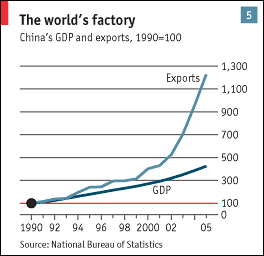
Over at UCI, Professor Peter Navaro has published his new book called The Coming China Wars. Navarro also wrote an interesting article for this week’s Barron’s Magazine that explains how the Chinese manufacturers can undercut competitors' prices by 30% to 50%. In the article, Navaro describes the University of California/Irvine's China Price Project which is in the process of examining the major economic drivers of China's competitive advantages to provide “clarity about how China became the world's factory.”

I plan to read Professor Navaro’s book on my iPod over the break. If you want to review the book for a Discussion Board post that would be grand. I’ll read this book with interest since I have had a long standing interest in China and the Chinese economy, having visited China on numerous occasions. I don’t care for the “war” metaphor, but I suppose that is what it takes to grab attention and sell books in a competitive media market.

Recently the online media has begun focusing on the implications of rapid economic development in China. The growth of China's economy has no equal in modern history. Since China set about reforming its economy more than a generation ago, its GDP has expanded at an annual rate of close to %. The country is closing in on a 30-year run during which its economy has doubled nearly three times. China’s surge is a revolutionary upheaval in global economic power, comparable to the rise of the US between 1860 and 1910.

For an interesting series of broadcasts and podcasts about the Chinese economy from the Marketplace radio show, click here.

China's growing importance in global macroeconomics raises a number of interesting questions that you can thrash out on the Discussion Board. For example:
1. Is the rapid development of the Chinese economy be good or bad for the U.S.?
2. Describe the ways in which the U.S. may benefit from greater economic development in China.
3. Describe the ways in which the U.S. may be harmed by greater economic development in China.
4. What macro policies should the U.S. adopt to adjust to China's growing economic importance?

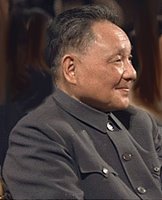
Extra Credit: Who is the guy in the picture? Critics and supporters alike agree that his reforms helped bring China closer to capitalism. If you are the first student to send me an e-mail (kwoodward@saddleback.edu) with the answer, you will be rewarded with two extra credit Discussion Board points. Only two points extra credit per student can be earned in any given week from the blog questions.


Saturday, November 11, 2006

China: Scapegoat or Sputnik


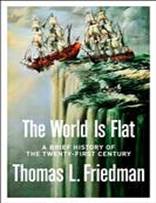
Those of you who are looking for a topic for a Discussion Board post might consider getting a copy of The World Is Flat: A Brief History of the Twenty-First Century. The author of the book is one of our country's most influential foreign affairs writers, New York Times columnist Thomas Friedman. I was impressed as usual with some of Friedman’s insights in an Op-Ed that he wrote yesterday in the New York Times (November 10) and I would like to share some excerpts:

Excerpts from: China: Scapegoat or Sputnik by Thomas Friedman.

“I still believe that when the history of this era is written, the trend that historians will cite as the most significant will not be 9/11 and the U.S. invasions of Afghanistan and Iraq. It will be the rise of China and India. How the world accommodates itself to these rising powers, and how America manages the economic opportunities and challenges they pose, is still the most important global trend to watch.

It really hits you when you see the supersize buildings sprouting in Shanghai, or when you look at the world through non-American eyes. Kishore Mahbubani, the dean of Singapore’s Lee Kuan Yew School of Public Policy, told me the other day that Asia right now “is the most optimistic place in the world.” More people have come out of poverty faster there — particularly in India and China — than at any time in the history of the world, and as a result, he notes, more people in Asia than anywhere else in the world today “wake up every morning sure that tomorrow is going to be better than yesterday.”…

Technology and globalization are flattening the global economic playing field today, enabling many more developing nations to compete for white-collar and blue-collar jobs once reserved for the developed world. This is one reason why growth in wages for the average U.S. worker has not been keeping pace with our growth in productivity and G.D.P.

“Economists call this phenomenon median wage stagnation,” noted The Financial Times. “Median measures give the best picture of what is happening to the middle class because, unlike mean or average wages, median wages are not pulled upwards by rapid gains at the top. As the joke goes: Bill Gates walks into a bar and, on average, everyone there becomes a millionaire. But the median does not change.”

Many Americans lately have started to get that joke, and it is one reason that with this new Democrat-led Congress we are likely to see a surge in protectionist legislation, more Wal-Mart bashing, a slowdown in free-trade expansion and increased calls for punitive actions if China doesn’t reduce its trade surplus — which surged to a record in October.

China, in other words, is inevitably going to move back to the center of U.S. politics, because it crystallizes the economic challenges faced by U.S. workers in the 21st century. The big question for me is, how will President Bush and the Democratic Congress use China: as a scapegoat or a Sputnik?

Will they use it as an excuse to avoid doing the hard things, because it’s all just China’s fault, or as an excuse to rally the country — as we did after the Soviets leapt ahead of us in the space race and launched Sputnik — to make the kind of comprehensive changes in health care, portability of pensions, entitlements and lifelong learning to give America’s middle class the best tools possible to thrive? A lot of history is going to turn on that answer, because if people don’t feel they have the tools or skills to thrive in a world without walls, the pressure to put up walls, especially against China, will steadily mount. “

I continue to believe that The World is Flat is worth a read or a listen if you want to understand globalization.

Extra Credit: What is the Chinese currency called? What is the current exchange rate between China’s currency and the U.S. dollar? Does China have a fixed or flexible exchange rate? If you are the first student to send me an e-mail (kwoodward@saddleback.edu) with the answer, you will be rewarded with two extra credit Discussion Board points. Only two points extra credit per student can be earned in any given week from the blog questions.

Wednesday, October 25, 2006

The rising wealth of nations


Robert Schiller, a Professor at Yale University, is one of the most creative macroeconomists around today. Lately he has been pretty gloomy about the short run prospects for the U.S. economy in part because of the unwinding of “irrational exuberance” in the housing market. While waiting for the Fed announcement today, I came across this interesting piece that was written by Schiller and was published in the Japan Times. I was surprised that Shiller has an optimistic outlook for worldwide GDP growth in coming decades:

The rising wealth of nations

By ROBERT J. SHILLER

NEW HAVEN, Connecticut -- The new Penn World Table, Version 6.2, comparing standards of living across countries, has just been released. The latest figures are for 2004, and, because of data lags, not all countries are included. Yet these numbers are valuable because they are of exceptional quality and they correct systematically for relative price differences across countries, which sometimes leads to surprising results.

Among the 82 countries for which 2004 data are now available, there is good news: Real per capita gross domestic product rose by an average of 18.9 percent between 2000 and 2004, or 4.4 percent per year. People generally were a lot better off than they were just a few years earlier. At that rate, real per capita GDP will double every 16 years.

Many people who could not afford a car in 2000 had one in 2004, and people who could afford only one car in 2000 had two. People who could not afford to send their children to a good school or college could. And so it was with many different goods and services that people consume.

One surprise is that there was relatively little change in the ranking of countries by real per capita GDP after 2000. Despite all the talk about the Chinese economic miracle, China's ranking rose only slightly, from 61st (out of 82 countries in 2000) to 60th in 2004 -- even though per capita real GDP grew by 44 percent between 2000 and 2004, or 9.6 percent a year, the highest of the major countries.

The reason China did not rise higher is that other countries were growing too, and because the gaps between countries were enormous. The range between the poorest and the richest countries in the world is a factor of more than 100. The average real per capita GDP of the top 25 percent of countries is 15 times that of the bottom 25 percent.

Watching these countries progress is like watching a marathon. At first, one is impressed by most of the runners, almost all of whom seem to be going fast. As they pass by, all spread out, one sees that some runners seem to be gaining rapidly. And yet they do not often overtake one another, because the distances between them are so large. Indeed, other runners are out of sight, perhaps miles ahead.

China isn't the only success story. Other big winners in terms of real per capita GDP between 2000 and 2004 were Lithuania (up 48 percent), Romania (up 41 percent), Estonia (up 40 percent), Chile (up 33 percent), Hungary (up 32 percent), Greece (up 31 percent), New Zealand (up 28 percent), Australia (up 25 percent), South Korea (up 23 percent), Ireland (up 23 percent), South Africa (up 23 percent), and Nigeria (up 22 percent).

Some of the worst performers among the major countries were Israel (a beleaguered country, with real per capita GDP up only 2 percent between 2000 and 2004) and Argentina (hit by a terrible financial crisis in 2001-2002, up only 9 percent between 2000 and 2004).

Economic performance in several Latin American countries was relatively weak in this period, with Uruguay's real GDP per capita actually recording a fall by a fraction of a percent. But the overall picture was amazingly good. If such growth rates continue, we will see relatively poor countries like India, Indonesia, the Philippines or Nicaragua reach the average levels currently enjoyed by advanced countries in 50 years. But, of course, they will not have caught up with these countries, for those countries will have moved ahead too.

It is hard to imagine now what that world will be like with a doubling or quadrupling of just about every country's GDP. What will all these countries do with all that money?

In 1958, the economist John Kenneth Galbraith wrote the best-selling book "The Affluent Society," in which he argued that the advanced world as typified by the United States had by that year finally emerged from "grim scarcity," when dire necessity dictated our lives, to a "world of affluence."

He wrote: "So great has been the change [in standards of living] that many of the desires of the individual are no longer even evident to him. They become so only as they are synthesized, elaborated and nurtured by advertising and salesmanship, and these, in turn, have become among our most important and talented professions."

Real per capita GDP in the United States is now three times higher than it was in 1958. What have people been spending all that extra money on? Is it all dictated by advertisers and salesmen who are inventing needs?

According to my calculations comparing 1958 and 2005 data from the U.S. Department of Commerce, Americans spent 27 percent of the huge increase in income between 1958 and 2005 on medical care, 23 percent on their homes, 12 percent on transportation, 10 percent on recreation, and 9 percent on personal business activities.

The kinds of things that advertisers and salesmen typically promote were relatively unimportant. Food got only 8 percent of the extra money, clothing only 3 percent, and personal care 1 percent.

Unfortunately, idealistic activities also received little of the extra money: 3 percent for welfare and religious activities, and a similar share for education. Thus most of the extra money was spent on health, a nice home, travel and relaxation, and doing a little business.

Maybe that is the way it will be around the world. As long as we can keep worldwide growth going at its current rate, billions of people can look forward to the same kind of improvement. And that should be truly inspirational.”

Robert J. Shiller is professor of economics at Yale University, chief economist at MacroMarkets LLC, which he cofounded (see macromarkets.com), and author of "Irrational Exuberance and the New Financial Order: Risk in the 21st Century." Copyright Project Syndicate 2006 (www.project-syndicate.org )

Read Chapters 6 and 8 in your text for more information on economic growth.

Extra Credit: What major country had the fastest growth in its standard of living between 2000-2005? If you are the first student to send me an e-mail (kwoodward@saddleback.edu) with the answer, you will be rewarded with two extra credit Discussion Board points. Only two points extra credit per student can be earned in any given week from the blog questions.

Thursday, October 19, 2006

Virtual Macro?


Edward Castronova has an interesting job as a MacroMind. Dr. Castronova, a professor of economics at Indiana University, studies virtual macroeconomics in synthetic worlds. Professor Castronova was interviewed this morning on the highly recommended Marketplace program on the subject of online gaming. Castronova is excited that for the first time we have big online societies with thousands of people in them that may allow us to explore “questions about how the macro economy operates.” He calls large online computer games "Petri dishes of macro economic theory." So far his research shows that economic theory seems to apply to the virtual as well as the “real” world. You can listen to the interview with Castronova here. I’ll have a lot more on virtual macro in upcoming posts. The subject would make for a fascinating Discussion Board post. Does anyone have a Second Life?

Back in the real macro world, the index of leading indicators for September barely budged. If you read Chapter 6 (pages 147-148) of your text you will find out that the leading indicators provide a rough approximation of what’s going to happen in the future. The index of leading economic indicators is rose 0.1% in September after falling in July and August. The leading indicators have been down in five of the past eight months. The index is down almost 1% in the last six months.

Will the macro landing be hard or soft? That is the question in Macroland these days. Stock market investors think things are peachy. The Dow Industrial Average reached another benchmark today, closing above 12000 for the first time.

Meanwhile China’s economy slowed to a still smoking growth rate of 10.4% in the third quarter. China has had the fastest growing major economy in the world for a generation.

Extra Credit: This question will likely be on your midterm. What has been the average annual rate of U.S. economic growth in real GDP since 1890? If you are the first student to send me an e-mail (kwoodward@saddleback.edu) with the answer, you will be rewarded with two extra credit Discussion Board points. Only two points extra credit per student can be earned in any given week from the blog questions.
Tuesday, October 17, 2006

Painting the Big Picture


There was a plethora of macro data released today. Inflation as measured by the Producer Price Index (PPI) came down in September, thanks to lower oil prices last month. The PPI measures changes in the cost of items purchased by businesses in wholesale markets. The PPI may give an early indication as to where overall inflation is headed. The drop was very sharp in the overall index, though the monthly change in core inflation (inflation excluding food and energy) was higher than many economists had expected. Tomorrow, we’ll get a look at the most closely watched measure of inflation, which is the Consumer Price Index (CPI).

The U.S. Census Bureau estimates that the population of the United States topped 300 million people today. We’ve still got a long way to go until we catch up with China, which is estimated to have about 1 billion and 300 million people.

In other macro news, the Federal Reserve said industrial production dropped in September by 0.6%, while capacity utilization fell 0.6% to 81.9%. Not so good.

I’m not sure quite what to make of all these numbers. Macrominds are always careful about reading too much into one month’s worth of data. To me the big picture points to a slowing of economic growth.

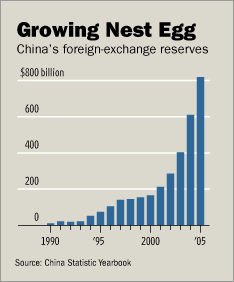
A story (at least in terms of its long run significance) that caught my attention was a report in The Wall Street Journal that China’s foreign exchange reserves had topped one trillion dollars:

"Sometime in the next few days, China's holdings of foreign currencies and securities will top $1 trillion -- a sum greater than the annual economic output of all but nine countries. The rapid growth in these so-called foreign-exchange reserves has made Beijing a colossus in the financial world, cushioned against shocks at home, but potentially able to trigger them abroad.

How China manages its growing pool of wealth has major repercussions for the global economy. … For the U.S., how China deploys its reserves is a question of some consequence. Most of China's currency reserves are invested in U.S.-dollar-denominated debt, such as U.S. Treasurys, which are considered the world's safest investment. That has kept demand for U.S. Treasury notes high -- and interest rates low. A change in that pattern could affect how much Americans pay for mortgage loans and other borrowings.

Some in Washington and in world markets fear that China might one day dump its holdings of dollar-based assets, setting off a tidal wave of sales that might swamp the U.S. economy. Despite such fears, there's no sign that China is making a major move out of dollars and into euros or other foreign currencies, even though Chinese economists have occasionally warned that the weak dollar holds down the value of China's holdings." (“China's Reserves near Milestone, Underscoring Its Financial Clout” by Andrew Browne, The Wall Street Journal, October 17, 2006)
Where did all these dollars in China come from? You might want to check out your clothes closet, toy chest, or consumer electronics.

Extra credit: What do economists mean by “core inflation”? Why is it important? The answer may not be in your text. If you are the first student to send me an e-mail (kwoodward@saddleback.edu) with the answer, you will be rewarded with two extra credit Discussion Board points. Only two points extra credit per student can be earned in any given week from the blog questions.
Sunday, October 15, 2006

Highly recommended


Four new sections of Economics 2 online start tomorrow. In honor of that event I’d like to make a big picture book recommendation that should provide plenty of material for Discussion Board posts. One of the main learning objectives of principles of macroeconomics course is to analyze globalization from an economics perspective. The book that I have in mind is called The World Is Flat: A Brief History of the Twenty-First Century. The author of the book is one of our country's most influential foreign affairs writers, New York Times columnist Thomas Friedman. The argument in the book is that globalization is the most influential trend of our times. With a focus on India and China, Friedman details the changes that globalization has brought to their societies as well as to America.


In a flat world you don’t have to attend MIT or Yale to hear Thomas Friedman discuss the ideas in his book. Follow this link to hear the author lecture about his ideas at MIT: http://mitworld.mit.edu/video/266/ Click here to hear Friedman interviewed at Yale (scroll down). For yet another recent interview with Thomas Friedman on the public TV show Foreign Exchange go to this link. The World is Flat is at bookstores and libraries everywhere. It has been at the top of the national non-fiction best seller lists for two years.


Friedman raises a host of issues that would be great topics for the Discussion Board. Don't ignore the last couple of chapters of the book, especially Friedman’s policy ideas on energy. Click here for some Discussion Board questions that you are welcome to tackle. Economists believe that you can’t understand globalization unless you understand concepts like comparative advantage, the law of one price, and convergence, which are discussed in your text and illustrated in The World is Flat.

The World is Flat may be the most important book that you read in college if you have any interest in what is going on in the world. Sometimes we might like to make the world go away, but it won’t. Its getting flatter all the time.

Extra credit: If you are the first student to send me an e-mail (kwoodward@saddleback.edu) identifying the name of the name of university that Friedman attended, you will be rewarded with two extra credit Discussion Board points. Only two points extra credit can be earned in any given week from the blog questions.


Sunday, October 08, 2006

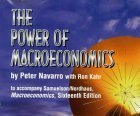
Macro Spotlight on Peter Navaro


Peter Navaro is a macro dynamo. Dr. Navaro teaches macroeconomics at the University of California at Irvine (UCI), and is a prolific writer. Professor Navaro has a special interest in the big –picture relationship between the stock market and the macroeconomy. He publishes a Daily Blog, and a Weekly Newsletter. The Weekly Newsletter is also available as a podcast.

These resources and much more are all available at Navaro’s website, called Peter Navarro's Well-Timed Strategies. Of particular interest to beginning macro students is Learn Economics, where students can download free multimedia lectures to learn the principles of macroeconomics (micro too).

Professor Navaro has an authored a new book called The Coming China Wars, which will be published sometime in October, 2006 by Prentice Hall. Here is the book jacket blurb: “China's breakneck industrialization is placing it on a collision course with the entire world. Tomorrow's China Wars will be fought over everything from decent jobs, livable wages, and leading-edge technologies to strategic resources such as oil, copper, and steel...even food, water, and air. In The Coming China Wars, best-selling author Peter Navarro previews all these potential conflicts—and reveals the urgent, radical decisions that must be made to avoid catastrophe.” I’ll read this book with great interest since I have had a long standing interest in China and the Chinese economy, having visited China on numerous occasions. I must confess that I don’t care for the “war” metaphor, but I suppose that is what it takes to grab attention and sell books in a competitive market.

A story that Navaro provides in his current Weekly Newsletter caught my eye, and that should be of interest to students who would like to do their Discussion Board post on the macro conditions in the housing markets:

“Longer term, I’d like to relate a conversation I had with a buddy who makes his living selling mortgages to the “Joe Sixpack” heart of America – his words, not mind. He’s on the phone 12 hours a day, hawking his wares all over the country so he’s a pretty good pulse on Americana. What he told me was a bit bone-chilling.

First, with the fall in housing prices, more and more people are hitting zero or negative equity in their homes. If rates rise further, more and more of these folks will walk away from their over-leveraged castles.

Second, and here’s the scary part, a lot of people now find themselves trapped in adjustable rate mortgages, unable to refinance. The reason is diabolical. With the fall in housing prices, they no longer have the equity and loan-to-value ratio to qualify for a new mortgage. So they are stuck in the ARMS of the bond market, and if interest rates do take off, these folks are going to take the worst whupping of their financial lives.

Lastly, the house as an ATM trend continues. But, my friend tells me, people are taking out smaller and smaller amounts because that’s all the equity that is left. Desperate to get cash to fuel their fantasies – or simply feed their families – these folks are likewise nearing the end of the dangerous rope.”


Saturday, October 07, 2006

“We've had a couple of hundred bad years, but now we're back."


Clyde Prestowitz of the Economic Strategy Institute has a fascinating post of his blog concerning the “Return of Asia”.


”If we look back at history, it seems that there are often long periods when nothing seems to change. And then at particular moments an unexpected shift occurs. A previously unknown gate swings open, and everything changes very quickly….The big question of our time is whether the leaders of the major countries and mankind in general will have the wisdom, foresight, and patience to adapt to these unprecedented changes.”

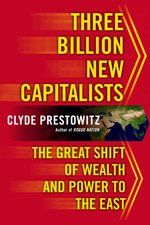
Prestowitz is the author of Three Billion New Capitalists: The Great Shift of Wealth and Power to the East.

Wednesday, October 04, 2006

Chinese cars are coming!


In today's New York Times is a story that I would bet has a lot of significance for our macro future. "Daimler and Chery of China Planning Subcompacts for U.S.," "DaimlerChrysler has reached a broad understanding with Chery Automobile of China to set up a joint venture to export cars to the United States for the first time.” The Wall Street Journal reports that General Motors and Nissan-Renault have terminated talks about a possible alliance.


It wasn’t so long ago that Chrysler (now part of Daimler) was an “American” company, and General Motors was the largest employer in the United States. What will be left of Detroit?