Showing posts with label federal funds rate. Show all posts

Friday, December 07, 2007

What will the Fed do next week? Wanna Bet?


The Federal Reserve Open Market Committee (FOMC) will be meeting next week. The buzz on the street is that the Fed will cut the target Fed Funds rate for the third time this year. The size of the interest rate cut will be a tough decision for the FOMC.


The Wall Street Journal had a nice article this week on the Fed's policy meeting next week which is useful for understanding the challenges of stimulating the economy in the face of a credit crunch. Click here to view the full article on WSJ.com


The Iowa Electronic Markets sponsored by the School of Business at the University of Iowa lets you “bet” (buy futures contracts) on whether the Fed will raise or lower rates. The Federal Reserve Monetary Policy Market is “a real-money futures market. Contract payoffs are determined by monetary policy decisions of the Federal Open Market Committee regarding the federal funds target rate.” You will get a big payoff if you buy a contract with a bet that the Fed will keep rates the same or raise them. Check it out.


Edward Gamber of Lafayette College who helps to edit the Weekly Review on Macroeconomics for the Wall Street Journal has prepared some questions that might be useful in writing a Discussion Board Post about the Fed:
1.) What is the Fed expected to do to the target interest rate at its December meeting? Why?

2.) What is the Fed expected to do to its policy statement at its December meeting? Why?

3.) What is the difference between the federal funds rate and the discount rate? What would be the benefit of reducing the discount rate along with the federal funds rate?

4.) Why are banks reluctant to lend?

5.) What policy tools in addition to the federal funds rate could the Fed use to stimulate lending and economic activity?

Extra Credit: You can answer one and only one of the following questions for extra credit this week: Who is on the FOMC? Explain and cite your source. OR what would the payoff be if you were to buy a futures contract now from the Iowa Electronics Markets that bet that the Fed will hold rates the same at its January 2008 meeting. In other words how much would you gain if you bet $1.00 that the Fed-Funds Rate target set at the FOMC meeting scheduled for January 29/30, 2008 is the same as it was the day after the December 2007 FOMC meeting. Explain. If you are the first student to send me an e-mail (kwoodward@saddleback.edu) with the answer, you will be rewarded with two extra credit Discussion Board points. Only two points extra credit per student can be earned in any given week from the blog questions

Thursday, November 01, 2007

The Fed cut rates


The Federal Reserve cut two important interest rates yesterday, and indicated that it may be reluctant to cut rates further in the future. The Fed is predicting a slowdown of growth.
Here is the Press Release from the Federal Reserve Open Market Committee (FOMC).
Press Release

Release Date: October 31, 2007

The Federal Open Market Committee decided today to lower its target for the federal funds rate 25 basis points to 4-1/2 percent.
Economic growth was solid in the third quarter, and strains in financial markets have eased somewhat on balance. However, the pace of economic expansion will likely slow in the near term, partly reflecting the intensification of the housing correction. Today’s action, combined with the policy action taken in September, should help forestall some of the adverse effects on the broader economy that might otherwise arise from the disruptions in financial markets and promote moderate growth over time.

Readings on core inflation have improved modestly this year, but recent increases in energy and commodity prices, among other factors, may put renewed upward pressure on inflation. In this context, the Committee judges that some inflation risks remain, and it will continue to monitor inflation developments carefully.

The Committee judges that, after this action, the upside risks to inflation roughly balance the downside risks to growth. The Committee will continue to assess the effects of financial and other developments on economic prospects and will act as needed to foster price stability and sustainable economic growth.

Voting for the FOMC monetary policy action were: Ben S. Bernanke, Chairman; Timothy F. Geithner, Vice Chairman; Charles L. Evans; Donald L. Kohn; Randall S. Kroszner; Frederic S. Mishkin; William Poole; Eric S. Rosengren; and Kevin M. Warsh. Voting against was Thomas M. Hoenig, who preferred no change in the federal funds rate at this meeting.

In a related action, the Board of Governors unanimously approved a 25-basis-point decrease in the discount rate to 5 percent. In taking this action, the Board approved the requests submitted by the Boards of Directors of the Federal Reserve Banks of New York, Richmond, Atlanta, Chicago, St. Louis, and San Francisco.

You’ll learn more about the Federal Reserve and monetary policy in Chapter 13 of your text.

Extra Credit: How many regularly scheduled open market meetings does the Federal Reserve Open Market Committee hold each year? When is the next meeting? If you are the first student to send me an e-mail (kwoodward@saddleback.edu) with the answers, you will be rewarded with two extra credit Discussion Board points. Only one blog extra credit question per student can be answered in any given week for Discussion Board extra credit.

Thursday, March 22, 2007

The Steady Fed


One of the main learning objectives in Economics 2 online is to understand the impact the Federal Reserve System and monetary policy. (Chapter 12 in the Colander text, Chapter 13 in Krugman and Wells)

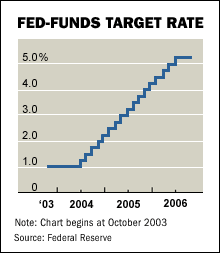
Yesterday, March 20 2007, The Federal Reserve decided to keep the all important federal funds rate steady at 5.25%. This lack of action was widely expected. The Fed has not changed rates for six straight meetings.

According to Bloomberg, which is an excellent source of economics news: “For the first time since the Fed ended a two-year run of interest-rate increases in August, the central bank yesterday signaled that its next move might be either to lower or raise borrowing costs, instead of just the latter. The Federal Open Market Committee's statement omitted a previous reference to ``additional firming'' in favor of the more general ``future policy adjustments.''

The shift indicates officials may have concluded the risks of a deeper recession in the housing market make it hard to raise rates to bring down inflation more quickly.”
Here is the full text of the Fed’s statement about the state of the economy:


“The Federal Open Market Committee decided today to raise its target for the federal funds rate by 25 basis points to 2-3/4 percent.

The Committee believes that, even after this action, the stance of monetary policy remains accommodative and, coupled with robust underlying growth in productivity, is providing ongoing support to economic activity. Output evidently continues to grow at a solid pace despite the rise in energy prices, and labor market conditions continue to improve gradually. Though longer-term inflation expectations remain well contained, pressures on inflation have picked up in recent months and pricing power is more evident. The rise in energy prices, however, has not notably fed through to core consumer prices.

The Committee perceives that, with appropriate monetary policy action, the upside and downside risks to the attainment of both sustainable growth and price stability should be kept roughly equal. With underlying inflation expected to be contained, the Committee believes that policy accommodation can be removed at a pace that is likely to be measured.

Nonetheless, the Committee will respond to changes in economic prospects as needed to fulfill its obligation to maintain price stability. “

The stock market moved higher after the release.

Extra Credit: How many regularly scheduled open market meetings does the Federal Reserve Open Market Committee hold each year? When is the next meeting? If you are the first student to send me an e-mail (kwoodward@saddleback.edu) with the answers, you will be rewarded with two extra credit Discussion Board points. Only one blog extra credit question per student can be answered in any given week for Discussion Board extra credit.

Friday, February 02, 2007

News of the Week from Macroland


One primary focus of Econ 2 online is to explain what causes macro numbers such as the GDP, unemployment rate, inflation, interest rates, exchange rates, etc., to go up and down (positive economics). Recent economic indicators have been mixed

This week there was a glut of news about the state of the overall economy. On Tuesday the government reported the economy’s GDP (Chapter 7) grew at a healthy 3.5% annual rate in the fourth quarter of 2006. A surge in consumer spending, helped by falling energy prices, boosted GDP growth.

Not long after that the Federal Reserve (Chapter 12) left the target for short-term interest rates at 5.25% for the fifth consecutive meeting. In a statement released after their meeting, the Federal Reserve Open Market Committee (FOMC) seemed more optimistic about both growth and inflation than the last time that it met in December. The central bank said its major concern is in the firs part of 2007 is inflation.

On Thursday, February 1, the Commerce Department announced the personal savings rate for American households for 2006. It wasn’t pretty. The personal savings rate is at its lowest level since the Great Depression of the 1930’s.


Finally, today on Friday, we got the Employment Situation Summary or jobs report for the economy. Overall we saw job modest growth in January, but things weren't so great in the manufacturing sector. Employers added 111,000 jobs to payrolls last month, according to the Labor Department report, down from a revised 206,000 jobs in December.
Extra Credit:
Today there are two extra credit questions. Answer only one if you are interested in earning extra credit.

1. What was the personal savings rate for all of 2006? What does this mean for our economy?

2. What was the overall unemployment rate in January 2007? Is the unemployment rate going up or down?

If you are the first student to send me an e-mail to kwoodward@saddleback.edu) with the answer to one of the questions, you will be rewarded with two extra credit Discussion Board points. Only two points extra credit per student can be earned in any given week from the blog questions.

Wednesday, October 25, 2006

No surprise: the Fed hits the pause button again


Here is the Press Release from the Federal Reserve Open Market Committee (FOMC). No surprises here for faithful readers of this blog. The bottom line: the FOMC is on pause when it comes to interest rates. We’ll get to look at the third quarter GDP report on Friday. The Fed is predicting a slowdown of growth.

Release Date: October 25, 2006

For immediate release

The Federal Open Market Committee decided today to keep its target for the federal funds rate at 5-1/4 percent.

Economic growth has slowed over the course of the year, partly reflecting a cooling of the housing market. Going forward, the economy seems likely to expand at a moderate pace.

Readings on core inflation have been elevated, and the high level of resource utilization has the potential to sustain inflation pressures. However, inflation pressures seem likely to moderate over time, reflecting reduced impetus from energy prices, contained inflation expectations, and the cumulative effects of monetary policy actions and other factors restraining aggregate demand.

Nonetheless, the Committee judges that some inflation risks remain. The extent and timing of any additional firming that may be needed to address these risks will depend on the evolution of the outlook for both inflation and economic growth, as implied by incoming information.

Voting for the FOMC monetary policy action were: Ben S. Bernanke, Chairman; Timothy F. Geithner, Vice Chairman; Susan S. Bies; Donald L. Kohn; Randall S. Kroszner; Frederic S. Mishkin; Sandra Pianalto; William Poole; Kevin M. Warsh; and Janet L. Yellen. Voting against was Jeffrey M. Lacker, who preferred an increase of 25 basis points in the federal funds rate target at this meeting.

Extra Credit: So what is the “federal funds rate”? You can bet you’ll be asked about this on your final exam. If you are the first student to send me an e-mail (kwoodward@saddleback.edu) with the answer, you will be rewarded with two extra credit Discussion Board points. Only two points extra credit per student can be earned in any given week from the blog questions.