Showing posts with label positive economics. Show all posts

Monday, June 04, 2007

Housing Update, June 2007


Orange County’s own Calculated Risk blog provides a comprehensive Housing Update, June 2007
“Here are a few simple facts:
• Housing inventories are at record levels, in both absolute terms, and as a percent of owner occupied units.
• Households are already dedicating a record percentage of their income to mortgage obligations.
• Banks are tightening mortgage-lending standards.

So what will happen to the housing market? For normal markets, these facts - excess supply, falling demand - would foreshadow falling prices. But, for housing, prices are sticky because sellers tend to want a price close to recent sales in their neighborhood, and buyers, sensing prices are declining, will wait for even lower prices. But sticky doesn't mean stuck. Prices are now falling by most measures, and will probably continue to fall. However, in a typical housing bust, prices tend to fall slowly over several years - so buyers wait, and transaction volumes also decline.”

You can read the whole blog entry here. “In conclusion, the outlook for housing remains dismal” and this puts a damper on the outlook for the macro economy.

Summer Session Extra Credit:
Read the entire Housing Update, June 2007 on Calculated Risk. Is the analysis an example of positive or normative economics? (See Chapter 2 in Krugman and Wells) Justify your answer. If you are the first Summer Session student to send me an e-mail at kwoodward@saddleback.edu with the answer, you will be rewarded with two extra credit Discussion Board points. Only one blog extra credit question per student can be answered in any given week for Discussion Board extra credit.

Friday, November 24, 2006

Macro blogging


Since overcoming my TV news addiction I increasingly rely on blogs for information about the macro world. The Los Angeles Times had an article yesterday about economics blogs yesterday (Thanksgiving). Let me share a few snippets from the LA Times piece:

“Of the top 100 sites in the blogosphere, four or five are about economics, said Brian Gongol, a small-business owner who compiles blog ratings and is an econo-blogger himself. That alone is surprising….

"What academics are interested in is ideas," said David Colander, an economics professor at Middlebury College who has studied how the discipline has evolved. "Whatever leads to the furtherance of those ideas, they're interested in."Colander is skeptical that the blogs will ever make economists into pop icons. (So am I!) He was one of 100 members of the profession featured on promotional trading cards issued in 1996 by a book publisher in a program called Economists Hall of Fame. Although the cards are still floating around, it's doubtful many kids collect them.
The market value of the economist cards — or anything else signed by economists — is still pretty low, Colander said. His advice for investors thinking of gambling on the idea that economists are the celebrities of the future?‘I'd say buy a baseball card instead.’”


I hope that if you are a student in my Econ 2 online class that you recognize David Colander’s name.

Two blog aggregators that allow the reader to skim through lots of econ blogs at once to look for issues of interest are Economics Roundtable and BlogNetBiz/Econ/Econ.

Greg Mankiw of Harvard, who was the former chair of the Council of Economics Advisors, has a stimulating blog that is often quite conservative in its normative economics. Brad DeLong, a former Clinton administration official, and now at Berkeley writes an equally provocative blog that leans to the left. Both of these blogs are among my favorites because they generally practice the “art of economics.”

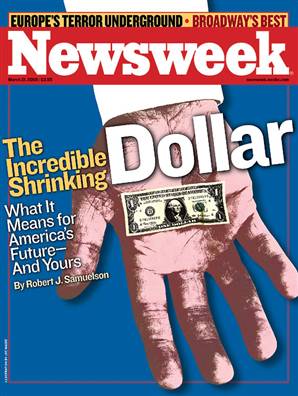
My crystal ball and psychic powers tell me that a major topic of conversation on the macro blogosphere in coming months will be the depreciation of the U.S. dollar. I hope that you will see why I think that way when you read Chapter 18 of your text. Then you’re done with the reading for the course. Whew! I hope that all of you had a restful Thanksgiving, and are ready to complete the home stretch of Econ 2 online.

Extra credit: What is the most visited blog that focuses on economics? What is the source of your information? If you are the first student to send me an e-mail (kwoodward@saddleback.edu) with the answer, you will be rewarded with two extra credit Discussion Board points. Only two points extra credit per student can be earned in any given week from the blog questions.

Monday, October 16, 2006

Macro Magic


My dissertation advisor kept telling me: “Know the data to be a good macroeconomist.” Data free conversations don’t cut it in macro.

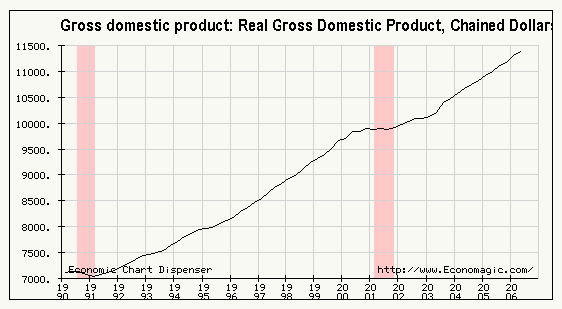
Economagic is great site for getting to know the macro data. Economagic was developed by an economics professor in Alabama to help his students. The idea was to give students easy access to large amounts of data, and to be able to quickly generate charts of that data. There are more than 200,000 time series for which data and customized charts can be retrieved. All the core macro stats that we are going to look at are there, including those on GDP, unemployment, inflation, exchange rates, etc. under the Most Requested Series tab. The site offers most of the data for free, but access to files in Excel, or copy-and-paste format, as well as forecasts is limited to paid subscribers. Hey, you don’t get rich teaching macro!

I have generated a chart of the recent path of real Gross Domestic Product (GDP) for the United States in less than a minute using Economagic. Real GDP is the number that macroeconomists use to keep their hand on the pulse of an economy. You’ll be learning a lot, maybe more than you wish to know, about GDP in the course, especially in Chapter 7 of your text.

Extra credit: When real GDP declines for six months or two quarters, what is happening in Macroland? Hint what are the shaded areas on the real GDP graph called? If you are the first student to send me an e-mail (kwoodward@saddleback.edu) with the answer, you will be rewarded with two extra credit Discussion Board points. Only two points extra credit per student can be earned in any given week from the blog questions.

I wish I had access to Economagic when I was doing my dissertation in the 1980's. In many ways the world is getting better.